
July 17, 2026
Across the threshold, through the years Farewell to Dr. Barbara McDonald
When visitors first come to The College of St. Scholastica’s main campus in Duluth, there’s no question about it: The sweeping stairs leading to the iconic Tower Hall’s main entrance are magnetic, no matter the weather. Embracing the grandeur of beautiful architecture and the Benedictine charism it represents draws in our community who yearn to put down roots and make this home.
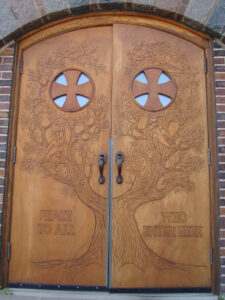 There is another set of doors to the west of Tower Hall, so fittingly positioned between the entrance to the College and Our Lady Queen of Peace Chapel. Carved into the warm mahogany is an intricate tree trunk, its lush branches a resting place for two doves perched above the benediction “Peace to all who enter here.”
Aptly named the Peace Doors, designed and hand-carved by Sister Mary Charles McGough ’50, OSB, these doors have been welcoming visitors since 1986: a 40-year Benedictine legacy of their own quiet, steadfast hospitality, welcoming all and receiving every guest across the threshold as if they were Christ. These doors have been a steady reminder of that concurrent call into community while reaching outward to connect with others.
Standing at the threshold
For seven years, President Barbara McDonald, Ed.D., stood at a threshold not unlike that one. She held it open for students who didn’t know if they belonged in the room. She walked through it into legislative chambers, board rooms, and Capitol hallways on behalf of an institution she believed in. She kept it open where it was possible during a pandemic, when every door on campus was being bolted shut, by finding new ways to say: “Come in. There’s still a place for you here.”
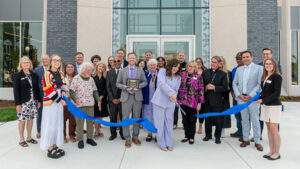 When Dr. McDonald retired on July 1, 2026, she left behind a campus transformed: a new Student Center, a completed comprehensive campaign, a 2030 Strategic Plan rooted in the College’s founding healthcare mission, a strengthened Catholic Benedictine identity, the expansion of graduate programming, and a community that weathered one of the most disruptive seasons in American higher education’s history.
From undergrad to president
Interestingly, Dr. McDonald journeyed the path at St. Scholastica during two very different chapters of her life: She was an undergraduate student here decades before serving as its thirteenth president. “I knew that if I ever had the opportunity to serve at a Catholic institution before I retired, it was something I wanted to do,” she said, looking back at the arc of a higher education career that began in the Minnesota State system. “Serving at a Catholic Benedictine college and, of course, The College of St. Scholastica specifically, was really kind of a dream come true.”
Stepping into the presidency of a small, private college after 22 years in the public system was a welcome change of pace; doing that in the midst of the global pandemic that hit in March 2020 — six months into her tenure, and just a month after inauguration — was an entirely different level of challenge to navigate.
Reimagining hospitality
In this season, hospitality, which she describes as one of the most foundational values to the College’s identity, had to be reimagined entirely. “Hospitality became virtual. Everything from hosting information sessions to happy hours to helping faculty and students learn how to learn in a distance modality was all part of inviting in, creating community in a new way.”
“Like with any crisis, you just have to refocus,” she continued, “and the Benedictine values led me along the way.” The steadiness that would come to define her leadership through this season was, in her own words, neither performance nor strategy. It came from something deeper: “This steadiness, I think, comes from faith in our Benedictine charism – the notion of stability and the value of community. We had to keep the community safe, and that really drove my determination.”
Benedictine innovation
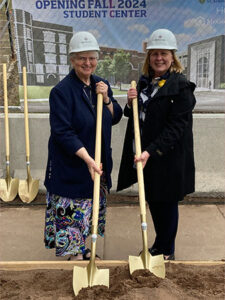 From the very beginning, Dr. McDonald embraced the friendship and mutual support of the Sisters of the St. Scholastica Monastery. Sister Beverly Raway, who served a 10-year term as prioress, was both a leadership partner and a Benedictine guide.
Dr. McDonald recalled an early conversation about change and innovation when Sister Beverly looked at her across the table with a quiet smile. “She said, ‘Well, you know, that’s always been the way it is with our Benedictine Sisters. Innovation is not a new concept to us. It’s something Benedictine communities have done for the last 1,500 years.’ I realized at that moment that I had a huge well of wisdom I could always touch and be present with.”
When asked what innovation she’s most excited to watch grow after she’s gone, she doesn’t hesitate: the strategic plan’s vision for expanding healthcare partnerships. “It was the very innovation that started the Sisters off in the first place, when they came and built St. Mary’s Hospital and then realized they needed to train nurses and also educators.”
The most important thing
As her time as president came to a close, Dr. McDonald found an alum unpacking boxes in a new office. Along the wall where he had placed a number of company awards, she spotted something unexpected. “Right in the middle of it, he had a large poster of the Benedictine values. And I said, ‘Oh, you have the Benedictine values right in the middle of your office.’ He said, ‘That’s the most important thing in my office. No matter where I go, I have them in front of me always, so that I remember what drives the core of my work.’”
“I think the biggest thing of all,” she added, “is just the importance of continuing to fully embrace our Catholic Benedictine identity. That’s what the world needs most — having our graduates as the leaders and the peacemakers of the future, being able to lead by virtue of having been at this College and taking these Catholic Benedictine values with them.”
The gift of transformative relationships
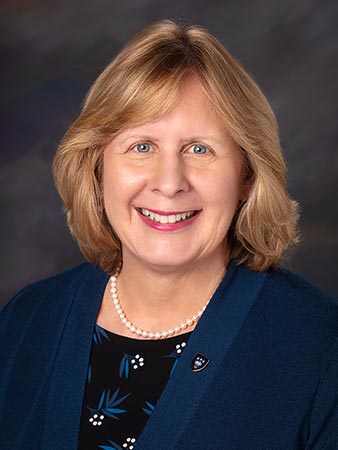
Over Dr. McDonald’s seven years as president of The College of St. Scholastica, more than 10,000 students have studied and earned degrees, carrying the values of this institution far and wide. The effort required to lead when times are easy is significant; the effort required to lead when times are unprecedently challenging is monumental.
For a unique perspective into Dr. McDonald’s presidency, we asked several leaders from the College’s wider community to share about the impact she made on the College and region and how the work she led has prepared us to step with confidence into the next season of our journey together.
Chris Dolan ’01 | Trustee Emeritus
An early ally
As then-Chair of the Board of Trustees and a member of the Presidential Search Committee, Chris Dolan ’01 was one of the first members of the Saints community to get to know Dr. McDonald well through the search process and the transition. The luck of living about a mile apart made it easy to meet weekly at a coffee shop to discuss the College, the Board’s vision, and her role. With his extensive lived experience, not only as the current Board chair but also as an alum who served on the Student Senate and as one of the first student representatives to the Board, Dolan was an excellent ambassador of institutional knowledge.
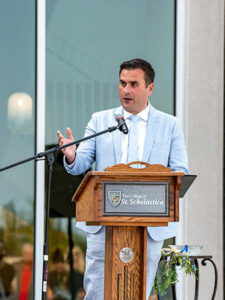 “I think Dr. McDonald was the right leader for the right time in the life of the College,” Dolan said. “It was a really tumultuous period, and she brought a calm and steady approach to her leadership. There were many things the College had to respond to that required quick action. All colleges were asked to really prove their worth, and she brought a very calm and steady approach to that work.”
Along with calm and steadiness, Dolan saw a willingness to be bold. He drew a direct correlation between today and the early days of the founding Sisters. “We think back, and it looks easy now because we have it, but it must have been an enormous challenge for those Sisters, facing really tough headwinds,” he said. “And I think the same of Barbara in the last seven years, even in really tough environments, to create a strong foundation for the College to keep building.”
Open to new approaches
With his alum roots and Trustee Emeritus commitment, Dolan seamlessly blends his vision of the College’s future with rich vignettes of heritage that are as simple as living our values: “Having been through a number of challenges and transitions, I think we just have to be open to new approaches. I think we can remember the boldness of our founders, live in that boldness, and use it to move us forward.”
He continued, “I’m hopeful for the future of the College; our fundamentals are strong. We’ll survive these storms as well and do the hard work to continue that vision of the College into the future. It may look different, but I think the impact it’ll have on our students and the way we instill those benefits and values into our students to be lifelong learners and live those values in their lives, that will continue because of the people at the institution.”
Sister Beverly Raway ’67, OSB | Prioress, St. Scholastica Monastery, 2015-2025
Keepers of the key
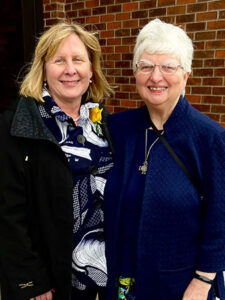 When Dr. McDonald arrived at St. Scholastica as president, Sister Beverly Raway was four years into her first term as Prioress of St. Scholastica Monastery, serving until 2025. “Those were good years, and Barbara made it very special to be working so closely with her during that time,” Sister Beverly shared.
“She brought many strengths as a president, including steadfastness, collaboration, and a willingness to listen deeply to understand the perspectives of others.” As they would soon discover, they would both practice these efforts repeatedly as they were thrust into managing the safety of students, faculty, staff, and Sisters together during the pandemic.
In the initial, uncertain days, weeks, and months of the pandemic, the two leaders began meeting twice a week to coordinate logistics and keep the campus safe and in compliance with Minnesota policies. “We learned to trust each other, and when you go through times like that with other leaders, it brings you closer together, on a very deep level. When you are in a position to both give and receive advice, that is a unique relationship,” Sister Beverly said.
“When there were difficult conflicts and hard decisions to make, Barbara leaned into her values, our Benedictine values, and her strong Catholic faith, and she wasn’t afraid to seek advice from the bishop, from me, [or] from the Monastery, to find ways to work through difficult situations. And, of course, her connections to civic organizations, leadership in the Chamber of Commerce, and her vast leadership experience in the state school system brought a lot of value to this work.”
Embodying the Benedictine values
From the beginning, Sister Beverly appreciated the ways Dr. McDonald embodied the College’s Benedictine values and championed their continuity across the student experience and community life at the institution. “These values are worth preserving and enhancing, making sure that there is a continued values-based education to develop leaders for the future, because we certainly need the kind of leaders that St. Scholastica produces out there, leading the charge,” Sister Beverly said.
She continued, “You know, when there is an environment with high polarization like we’re living in today, to be able to sit down with people who have radically different ideas and not become antagonistic is a gift; I think the focus on preparing leaders with that kind of listening attitude is what this school is all about. Being able to sit down and talk about different viewpoints without becoming antagonistic. That’s the key.”
Most Reverend Daniel J. Felton | Bishop of Duluth
Catholic identity collaborators
Stewarding the College’s Catholic Benedictine mission and vision is a shared responsibility of the Saints community as a whole, but is especially sacred to the leaders of the institutions. In May 2021, Dr. McDonald and Sister Beverly gained an eager collaborator when Bishop Daniel Felton joined the Twin Ports community. “When I was appointed to be the bishop of the Diocese of Duluth, one of the first questions I asked was about our Catholic schools, and I was pleasantly surprised to find out about The College of St. Scholastica,” Bishop Felton said.
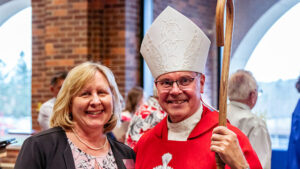 The two leaders began meeting regularly when Bishop Felton arrived in Duluth. As the bishop of the diocese where the College is located, he is responsible for supporting the College and its Catholic identity. Bishop Felton sees the impact of five years of intentional work together in two key areas: the College’s recently adopted Catholic Identity Statement and the deepening connections between Campus Ministry and the diocese.
He shared, “I’ve worked collaboratively with Dr. Barbara and, while she was prioress, Sister Beverly, to constantly be in a good conversation about how to promote the Catholic identity while remaining sensitive to the diverse community that calls the College home. I found working with her to be a great experience, and that we’ve been able to make an impact on the Catholic identity of the school itself, along with the emphasis on Benedictine values.”
Staying connected
Bishop Felton’s interest in Catholic higher education didn’t start when he moved to Duluth. He has served on the St. Norbert College Board of Trustees and the Silver Lake College Board of Directors, and he appreciates the importance of staying connected to the rapidly changing landscape. “Dr. Barbara stayed very cognizant of the trending issues in higher education and was very diligent about being part of organizations and structures that speak to the challenges of higher education,” he said.
On a personal level, Bishop Felton reflected on her unique balance of authenticity and authority. “I experienced Dr. Barbara as a person who was real and honest: real about her family and herself, but [someone who] never had a need to put on a façade or airs of the office itself. She felt comfortable being herself and knew who she was, what was important in the moment, and what her priorities were,” he said. “To me, that always spoke of being firmly grounded in the values of what’s important and not important in our lives.”
Owen Erickson ’26 | Student Trustee
Keeping the tradition alive
One of the voices at the table with a view into the highest levels of student government and the College over the past two years was Owen Erickson ’26, the student representative to the Board of Trustees. Erickson served three years on the Student Government Association (SGA), first as a general elected senator and then as a two-year trustee. As a freshman, he asked to sit in on the weekly meetings between President McDonald and SGA President Maddy Ploof ’25.
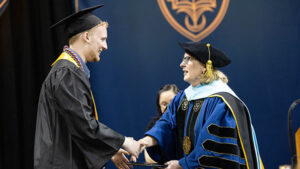 “I was really interested in the work they were doing together,” Erickson said. “After meeting with them and having additional conversations, I applied for the trustee position and was nominated. And then I started meeting with Dr. McDonald more often and having more meaningful conversations.” He didn’t realize until later that these early conversations were a preview of the experience he would have as he stepped into his role on the Board.
“I was welcomed really well to the Board of Trustees, especially in a space where I’m the least accomplished,” Erickson shared. “Working with folks who are CEOs of multimillion-dollar organizations, I just felt a little bit out of place. Dr. McDonald did a really great job of making me feel a sense of belonging and included. I’ve brought that intentionality into my work with students. I want to help make sure that when they take a bold step to advocate for something, they know and feel that they are seen and heard.”
Making better people
Advocacy has always been a visible part of the Saints community, including support for programs like TRIO. As a first-generation college student, Erickson was selected to join 29 other TRIO college students in April 2025 for the inaugural TRIO Future Leaders Summit in Washington, D.C. “With the recent uncertainty and risks of losing federal funding, Dr. McDonald’s support for all the TRIO programs has been very inspiring,” he said.
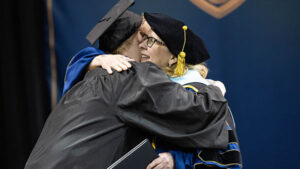 As Erickson steps out the doors and leaves St. Scholastica, he reflects on the beginning of his Board term. “One of the first questions I answered on the Board of Trustees was, ‘What does St. Scholastica do really well?’ And my answer was, ‘CSS doesn’t just make better students; it makes better people who contribute to meaningful work,’” he said. “I want people to see the accomplishments — the people we become as we spend our time and grow and learn here — and choose St. Scholastica as a destination for mission-driven, personal, and professional development.”