December 19, 2025
Sleep, Leap, Creep: A perennial approach to sustainable campus gardens
Caring for a 186-acre campus in all seasons is no small task. Committing the time and resources to ensure the space is also a beautiful reflection of the institutions it supports requires next-level intention and creativity. With rising costs and fewer individuals able to dedicate time and expertise to the work, the Garden Committee was inspired to embrace native species gardens to fill in the gaps.
Judi Morwood, coordinator for the School of Arts and Sciences and a member of the Garden Committee, has been a champion for the gardens since joining the committee in 2023. After learning more about the history and work of the Garden Committee, she realized the previous vision for the spaces was out of reach for the available resources. “We simply didn’t have the capacity to do the work: choose and plant the annuals or water and weed them as often as they needed,” Morwood said. “So I talked with the other three committee chairs — Amy Fink, Robyn Jones, and Matt Hoeschen — about shifting to native plants. They were on board, so we worked together to propose a plan to Cabinet, which was approved fall 2024 with the funding we needed to get started on the project.”
Embracing native species
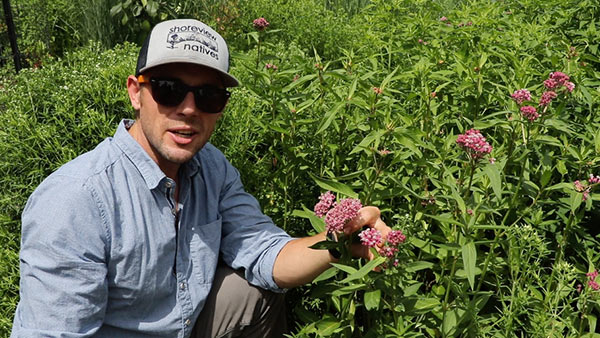
To ensure the College is equipped to make the most of its garden spaces, the Garden Committee partnered with Shoreview Natives, a local and regional native plant authority that provides education and expertise in shaping and creating gardens. Owner Dan Schutte brings years of experience as an environmental educator and a former Peace Corps beekeeper, who began growing native plants in 2011 as a side project and started the business in 2015. He went full-time with Shoreview Natives — his self-described “hobby gone wild”— in 2020 and has since added a retail store and commercial greenhouse.
Working within existing spaces creates constraints, especially when they have a long history and sentimental value. Schutte and his team were careful in the planning and execution to ensure continuity with the gardens.
Honoring past effort
 He said, “It was cool to work in the existing gardens. People weighed in and had opinions on what should stay and what should be swapped out. So a few times we wanted to save this plant, and we took it out, prepped the site, and planted it back in. We also saved a number of spring bulbs that were planted back in the gardens this fall. People have put time and effort into these gardens, so it’s cool to be able to maintain some of that.”
Perennial gardens require more time and patience to see the potential of a site realized, which is where the phrase “sleep, creep, leap” comes into play; the plants need time to get comfortable before they produce more flowers and color. Over time, as the native plants settle and thrive, they naturally fill in the space and reduce the overall maintenance required. As Schutte explained, “Over the next couple of years, the maintenance is going to reduce. It’s counterintuitive because you expect that the more plants there are, the more work they will require, but the opposite is true.”
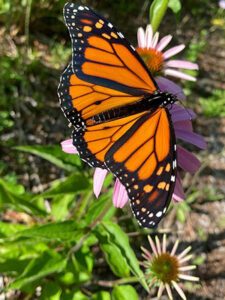
At the same time, the plants provide food and habitat for birds, butterflies, and other pollinating insects, whose populations are in steep decline. This pollinator support, combined with reducing stormwater runoff, reducing mowing, creating educational opportunities, and adding year-round interest and beauty to spaces, has made native plantings a popular alternative to grass lawns.
A committee takes root
As the first chair of the Garden Committee, launched in 2008, Sister Mary Josephine Torborg remembers well the labor of love that built and sustained the garden spaces over the years. A faculty member in the religious studies department at the time, she walked into a meeting about the possibility of adding gardens to campus and walked out with a committee, a charge to beautify campus for the community and prospective students, and no budget. Undeterred, they secured a future budget from the College and began raising additional funds through craft sales.

Members of the baseball team take a break from volunteer work in the Angelus Garden in fall 2021 with Sister Mary Josephine Torborg.
The group built out the spaces and the retaining wall of the Magnificat Garden brick by brick with the blessing of Tom Brekke, the facilities director at the time. “After we had the budget every year, we would always ask for volunteers for planting day, and people would volunteer for an hour or two to help us get all the things planted,” Sister Mary Josephine shared.
“And then there was the upkeep, including watering, as there was no water source available near the Kenwood entrances for both of those gardens. Many times, I had eight pails of water in my trunk to drive down; whenever it needed watering, we’d make three or four trips with the car. It was a process, it was a lot of work, but it kept the gardens going. And then the weeding! We just all kept working at it.”
From gardening to Christmas decorating
Just over a year into the new committee’s work, Sister Mary Josephine said they received a letter from President Larry Goodwin. “He said, ‘I would like the Garden Committee to be responsible for decorating the campus at Christmas,’ because nothing was being put up. Really nothing,” she remembered. “Not a light, not an ornament. So I went to him as committee chair and I said, ‘The committee is willing to do this, but we have no money. We raised money to buy flowers, and they’re planted.’ So he sent me to see what we had in the garage, and there was nothing.” Sister Mary Josephine and the committee agreed to take on Christmas decorating if the president could find the budget for decorations.
Finding deals and building traditions
They agreed to a $1,000 budget dispersed in $500 increments. The timing for their first disbursement was perfect, and Sister Mary Josephine headed to the mall the day after Christmas to find some deals: “The Christmas store had a sale. Their trees that were originally $750 were $100. We bought three trees and an eight-foot wreath that we’re still using. And if you bought one set of lights, you got two free. So we bought 18 sets of white lights and helped to clear them out. And all of a sudden I realized I don’t have my tax exempt card. So I called Tom and asked him for the tax exemption number because they agreed to take it over the phone. I said him, ‘If we’re over a little bit on the $500, what should we do?’ And he asked what we bought and I told him and he said, ‘For heaven’s sake, buy it!’ I think we found some good deals.”
A sustainable mindset for the future
To successfully pivot to a new garden model that meets the campus’s needs and aligns with a sustainable plan for the future, while honoring the past, community collaboration is essential. The vision developed and championed by the Garden Committee and supported by the administration and the facilities team is well on its way. Morwood is pleased with the collaboration on campus and with partners like Schutte and Shoreview Natives. Schutte said, “I think everybody at St. Scholastica has been so fun to work with. The Sisters are just awesome to talk with and work with, so it’s been enjoyable for a lot of reasons.”
Morwood explained, “We have taken this direction to create relatively maintenance-free, environmentally responsible gardens that ring true to our Benedictine values of respect, stewardship, and hospitality. By incorporating native plants, we can create a sustainable solution that not only reduces maintenance and water requirements but also enhances the beauty of our campus and provides a welcoming habitat for our pollinators, along with a visually welcoming space for our students and future families.”