August 6, 2026
What a hoot: Campus owls, crows, and a community that pays attention
At The College of St. Scholastica, we are fortunate to have regular reminders that our community extends beyond those who work, teach, and study at the main campus in Duluth, MN. Our wooded grounds are home to an impressive variety of flora and fauna, including more than 140 species of birds documented since 1978. This list initiated by former biology faculty member Sister Donna Schroeder ’61, OSB, and carried on in recent years by the College Library through its Catalog of Birds.
Among our local birds, there is always something magical about a sighting of any of the four owl species that have been observed here. The recent appearance of a family of Great Horned Owls near our campus buildings has been a meaningful reminder of our College’s special connection to the natural world.
A storybook owl moves in
The Great Horned Owl might be the most familiar of the owl species, and it is certainly the most “scholarly” in appearance, so its presence on our grounds seems fitting. The Cornell Lab of Ornithology’s outstanding All About Birds website describes the species’ “long, earlike tufts, intimidating yellow-eyed stare, and deep hooting voice,” calling it the “quintessential owl of storybooks.”
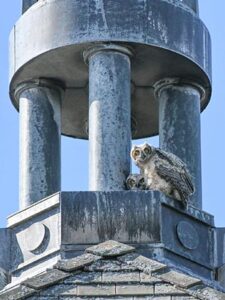
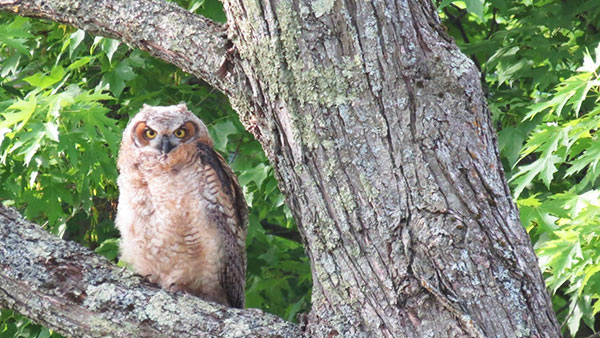
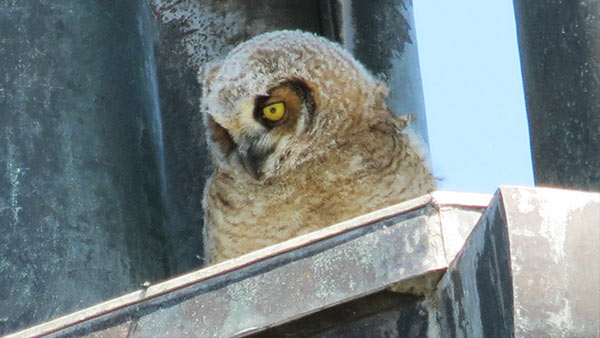
Great Horned Owls, Brad Snelling
It was thanks to a tip from Sister Lois Eckes ’69, OSB — who spotted one of the adult Great Horned Owls in a Green Ash tree from her room at the Monastery — that the Library first learned of the owl family. The owls likely nested in front of Stanbrook Hall before relocating to the spruce and Silver Maple near the St. Scholastica Theatre. As they moved to the area behind our campus buildings in late May, the owls offered a memorable photo op, spending a Sunday afternoon in the steeple above Our Lady Queen of Peace Chapel and the College Library.
Among those who photographed the owls during this time was Sister Beverly Raway ’67, OSB, an avid birder who has served on the Hawk Ridge Management Committee and was an early member of the Duluth Audubon Society. She captured several stunning images, including a beautiful shot of one of the juveniles perched in a Silver Maple near the St. Scholastica Theatre.
A well-timed walk with Laura Erickson
As luck would have it, the recent sightings coincided with a campus walk led by nationally known ornithologist and author Laura Erickson, an event the Library planned this spring with the College Wellness program and members of the Faculty-Staff Hiking Club. At the start of the walk, Erickson took time to discuss Great Horned Owls, including the juveniles of the new family, which had likely fledged (left their nest) in the weeks before.
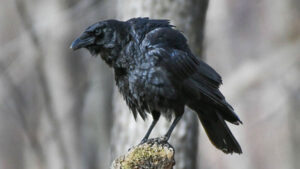
This past spring, the best way to find the owls was to follow the crows, and on the walk, Erickson explained why. She described the daytime “mobbing” behavior of American Crows, which often draws human attention to the presence of owls. Crows gather in large numbers during the day in a collective attempt to harass and dislodge owls, which pose a genuine threat to them; they are especially vulnerable at night, when they cannot see or evade their predators.
While other species mob predators too, crows stand out for their aggressiveness. In Owls of North America and the Caribbean, held in the CSS Library’s Reference Collection, Scott Weidensaul writes that “no other birds mob them [Great Horned Owls] with the tenacity and sheer hell-for-leather passion as crows.” More than once, that cacophonous mobbing was exactly what led campus birders to our own Great Horned Owls.
The other owls of St. Scholastica
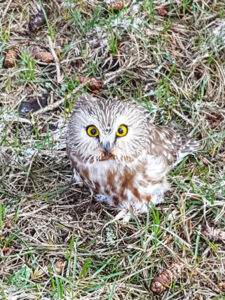
Saw-whet Owl, Dr. Pamela Freeman
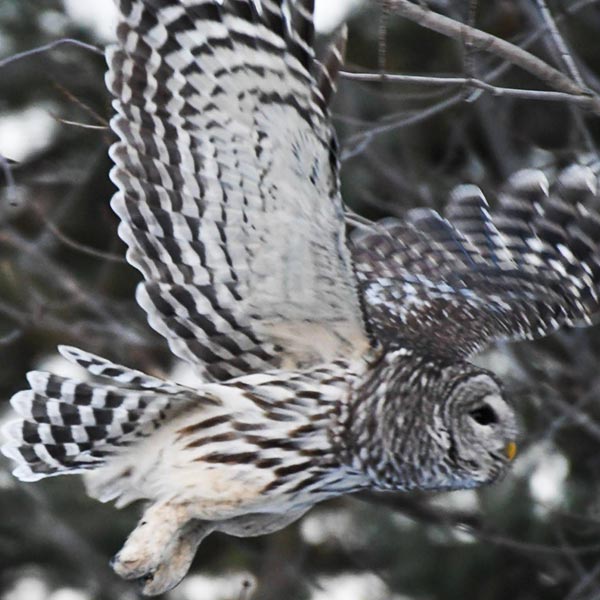
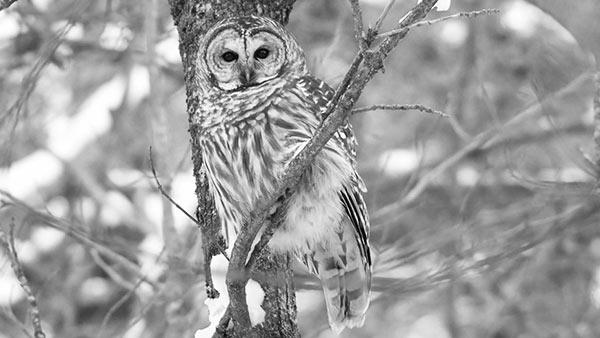
The Barred Owl is the most common among the other documented owl species on campus. Sister Gretchen Johnston ’04 (MBA ’26), OSB, saw one on a campus trail overlooking the Valley of Silence in late March, and Barred Owls have also been photographed in recent years on campus paths and near the entrance to Gethsemane Cemetery.
The less common Northern Saw-whet Owl and Snowy Owl round out the campus species list: Associate Professor of Biology Dr. Pamela Freeman photographed a Saw-whet Owl on the lawn of the Science Center in 2021, and a campus visitor photographed a Snowy Owl near the St. Scholastica Theatre in early 2022.
A community that pays attention
The Great Horned Owls have since moved on, as owls do. But for a few weeks this spring, they turned our campus surroundings into a place of shared curiosity.
None of this is new at The College of St. Scholastica. It stretches back to the list Sister Donna Schroeder began in 1978 and continues today in the Library’s Catalog of Birds, one sighting at a time. The owls remind us that our campus community reaches well beyond the people who fill its buildings. All we have to do is pay attention.