June 18, 2026
Sing Democracy 250
On Jan. 24, Richard Carrick, associate professor of Music and director of Choral Activities, landed at the Minneapolis-St. Paul airport, and the news of Alex Pretti’s shooting was waiting as he turned his phone on. He’d just returned from a concert premiere in Texas, and as he realized that while he was looking down at the neighborhoods where he used to live during his descent to the airport, a consequential event was unfolding, and the weight of what was happening in Minnesota settled on him. He spent most of that Sunday asking himself one question: How do I go to work tomorrow and just run a normal rehearsal?
The answer, it turned out, was that he couldn’t. And so instead of running a normal rehearsal, he opened the doors wider.
A way to process
He sent a simple email to the St. Scholastica campus community inviting them to “come sing with us.” About 50 people showed up, in person and online. They formed a circle on stage and learned a few songs from the Justice Choir songbook, including Hold On, a song that had been echoing through Minneapolis that season. They made space for people to speak, and they sang.
“There’s something about singing that is so human and essential to how we communicate,” Carrick said. “It can be a really powerful way of processing hard things.” That instinct to turn to art as a way to grapple with and move through hard questions was an oft-used theme throughout the year, both as a means of personal engagement and as a way to celebrate and study the very foundations of our country through Sing Democracy 250.
A timely project for a big birthday
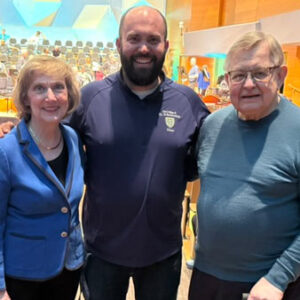
Sing Democracy 250’s co-founders Celia Ellingson and Gary Aamodt with Richard Carrick (center).
Sing Democracy 250 began with a simple but ambitious idea: gather choirs from all 50 states to mark the 250th anniversary of the Declaration of Independence, not with ceremony but with song. Founded by Twin Cities-based nonprofit Together In Hope Project and co-founders Gary Aamodt and Celia Ellingson, the project commissioned two new choral works designed to spark honest, cross-partisan reflection on what American democracy has been, what it has failed to be, and what it still might become.
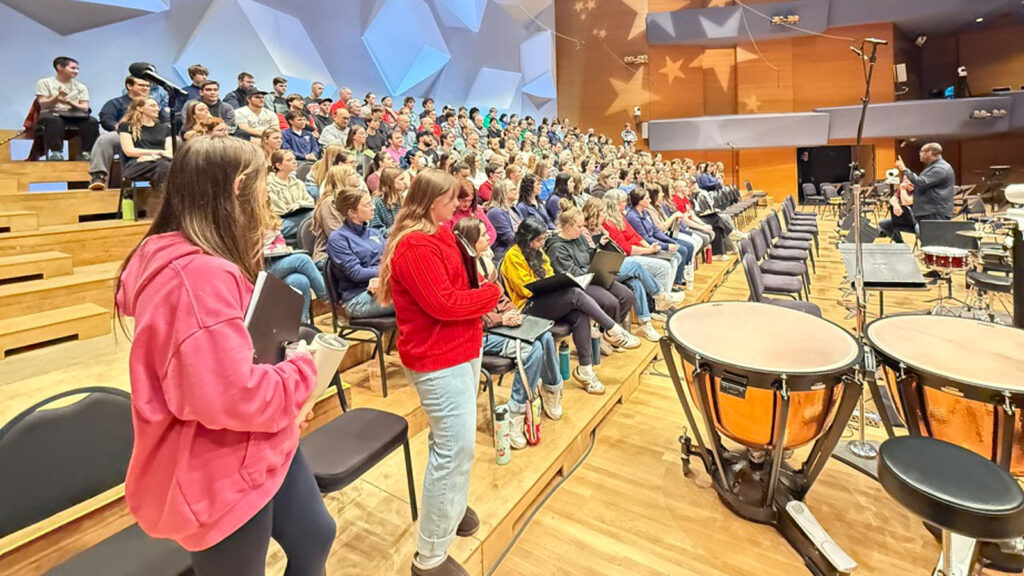
St. Scholastica’s Concert Choir was invited to participate in the Minneapolis marquee concert, one of four signature events held across the country, and the only one professionally recorded. Held at Orchestra Hall with the Metropolitan Symphony Orchestra and nearly 200 singers from across the state, the concert will air on Minnesota Public Radio this July 4th, with a PBS broadcast to follow this fall.
Music written for now
The two commissioned works, each approaching the question of American democracy from a different angle, and neither one shying away from the complexity of the task. “Redeem the Dream,” composed by Brandon Boyd, opens with the first line of the Declaration of Independence and weaves in Langston Hughes’ poem “Let America Be America” — a work that holds both the grief of a promise broken and the stubborn insistence that this promise still matters.
“US,” composed by Michael Buszowski-Quarm, draws on a deliberately wide range of American voices: Thomas Jefferson and Frederick Douglass, John Lewis and Abraham Lincoln, Barack Obama and Ronald Reagan. This framework comes from Richard Haas’ book “Bill of Obligations: The Ten Habits of Good Citizens,” which argues that a functioning democracy depends not only on rights but also on the active responsibilities citizens owe one another and to the common good.
“They were trying to create an event that wasn’t partisan,” Carrick said, “but would bring in representatives from all sides of the political spectrum, to talk about what our obligations as citizens really are.”
Exploring all sides of the political spectrum
For Carrick and his students, engaging with this music meant engaging with the full arc of American history — the founding ideals, the places they fell short, and the work required of citizens today to live into them. It meant reading Langston Hughes carefully, in context, and asking hard questions about “whose America” the founding documents described, and whose they didn’t. It meant sitting with the distance between what was written and what was true, and finding, in that distance, not cynicism but a kind of urgent hope.
“This is a beautiful dream that they set forth,” Carrick reflected, “that we have yet to realize and live into. What is the American dream? Who is it for? What can we do to make things more equal for everybody? How do we hold the dignity of all humans?” Those are questions an education at St. Scholastica is built to ask.
Bringing it home: Orchestra Hall to Mitchell Auditorium
After the long day of rehearsals at Orchestra Hall — buses at 6:45 a.m., eight hours on their feet, a full orchestra surrounding them — the choir performed the concert, which was recorded for national broadcast, and came home to Duluth.
A few weeks later, they performed the same music again, only this time, it was with 30 voices instead of 250; a piano trio instead of a full orchestra; the Mitchell Auditorium instead of Orchestra Hall. Carrick emphasized that just because the venue was smaller doesn’t mean the performance wasn’t just as meaningful.
“To see the choir deliver this music and message in such a powerful way in both contexts was really cool,” Carrick said. “As a conductor, you get to look at your ensemble as they’re making music. You’re just trying to draw it out of them — and to see their energy and their eyes light up was really, really special.”
Wrestling with something bigger than yourself
He’d been nervous going into the year, he admitted. This wasn’t a lighthearted program, and it wasn’t an easy year. It asked students to wrestle with history, with contemporary life, with questions about citizenship and responsibility, and what it means to be part of something larger than yourself. He never doubted they could do it, but he knew it wouldn’t be easy. “I knew it was important and I was excited to do it,” he said. “But I also knew: This is not going to just be singing pretty music.”
For Carrick and the St. Scholastica music program, that’s not unique to this year or this project, but it provided the choir and the wider community with a space to explore the larger questions that don’t have easy, quick answers. “How do we have disagreement without hatred? How do we keep the humanity in these conversations instead of going to our silos?”