November 24, 2026
Rooted in connection
St. Scholastica advances Relational-Cultural Theory through a first-of-its-kind certificate program
Fifty years ago, psychiatrist Jean Baker Miller published a slim book with a quietly radical premise: People grow through relationships, not in spite of them. “Toward a New Psychology of Women” challenged a field that had long equated maturity with independence and helped establish what is now known as Relational-Cultural Theory (RCT). Today, that work has a home at The College of St. Scholastica.
In September 2025, the Center for Professional Training and Lifelong Learning launched an advanced training certificate in RCT in collaboration with the International Center for Growth in Connection (ICGC). The online program connects practitioners across the country with scholars who helped develop the theory, combining its intellectual foundations with practical applications.
Career-focusing work
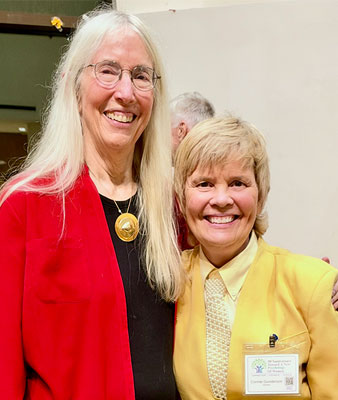
Program lead Connie Gunderson, PhD, associate professor of social work, has built her career around RCT. She reflects on the theory’s influence, the certificate’s development, and St. Scholastica’s growing role in carrying the work forward.
Q: When did you first encounter RCT, and what drew you to it?
A: I was introduced to RCT in the early 1990s while working on my master’s thesis about women, trauma, and addiction. I was living in Germany when I spoke with Judy Jordan, one of the founding scholars, who invited me to a training at Wellesley College.
What clicked for me was that RCT is both a developmental theory and a therapeutic approach. It centers the integrity and importance of relationships throughout the lifespan while addressing social and ecological responsibility and justice. I was deeply moved by the empathy and care we shared and by the way the theory honors the neuroscience of connection.
Q: You have said RCT became the foundation of your career. What made the theory distinctive at the time?
A: The founding scholars were women working in a field where women’s experiences and voices were often not represented. Jean Baker Miller examined the destructive consequences of domination and subordination and argued that placing relationships at the center of human development “changes everything.”
RCT challenged the idea that maturity requires becoming increasingly separate and self-sufficient. Instead, it recognized that development happens through relationships. It also considered how race, culture, sexuality, and sociopolitical power shape a person’s intersecting identities. That framework offered a powerful reworking of the dominant psychological theories of the time.
Q: How did the 2016 “Transforming Community” conference at St. Scholastica help lead to today’s certificate?
A: The conference brought 172 people from 20 states, two Canadian provinces, and two other countries to St. Scholastica. Participants ranged from teenagers to people in their 70s, including longtime RCT practitioners, students, and community members. We explored healthcare, neuroscience, education, the environment, and social justice.
I organized the conference to introduce RCT to the St. Scholastica community and the region. The College welcomed participants warmly, and it was clear that we shared many values and goals. I asked Judy Jordan what she thought about creating an RCT certificate at St. Scholastica. She said yes, and we began building an international program together.
Q: How does your work as a therapist shape the way you teach RCT?
A: RCT reminds us that we are all works in progress. Teaching and learning are relational practices, so my students matter deeply to me. They learn the history and framework of RCT and how to apply it with clients of all ages.
I also invite students to consider how their values, life stories, and experiences influence their perceptions when working with others. They explore their professional passions and build relationships with RCT mentors and practitioners around the world. I value those relationships, and I enjoy saying, “I have the best students in the world.”
Building an international program
Q: How did the partnership between St. Scholastica and ICGC develop?
A: I began working with what was then the Jean Baker Miller Training Institute at Wellesley College while living in Germany. Alongside my research on sex trafficking, I taught and conducted research at HAWK University of Applied Sciences and Alice Salomon University of Applied Sciences Berlin.
In 2012, I invited RCT scholars to lead a three-day European symposium on a relational-cultural approach to addressing sex trafficking. When I returned to the United States and joined St. Scholastica’s social work program, I wanted to continue collaborating with them.
Q: How did founding scholars and experienced practitioners become involved in the certificate?
A: I invited them, but collaboration has always been central to RCT. This is a “we” program. Scholars, practitioners, and students bring different knowledge, insights, and experiences, and we learn from one another in a mutually respectful way.
Q: What does their involvement offer participants?
A: Students have the opportunity to learn directly from RCT elders and longtime practitioners. We honor “the shoulders we stand on” while preparing the next generation to carry this work forward. Transformation through connection is not only viable but necessary as we work to heal one another and care for our planet. Mutual engagement is essential to our individual and collective survival.
Q: Who was instrumental in developing the program?
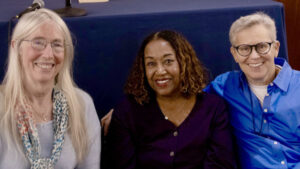
Judy Jordan, Maureen Walker, and Amy Banks
A: Judy Jordan, PhD; Amy Banks, MD; Maureen Walker, PhD; and Taylor Gunderson made important contributions. Taylor was deeply involved in developing the current program and brought valuable research and publishing expertise to a complex undertaking. I am also grateful to the Irene Stiver Foundation, which provides scholarships for participants.
The certificate emphasizes practical application. Participants learn tools including the C.A.R.E. program and the RCT-Lens Bio-Psycho-Social-Spiritual Assessment, then build a portfolio of resources tailored to their work.
Q: In plain language, how do the C.A.R.E. program and RCT-Lens Assessment help practitioners?
A: The C.A.R.E. program draws on the neuroscience of RCT and helps practitioners consider both a person’s relationships and the social context in which they live. Clients explore the neural pathways that affect their sense of calm, acceptance, resonance, and energy in relationships. The program can support assessment, intervention, and evaluation.
The RCT-Lens Assessment focuses on relationships and relational movement. Practitioners consider a client’s connections, traumatic disconnections, capacity for authenticity and empathy, participation in mutual relationships, response to conflict, and sense of being valued by others.
In October 2025, the field marked the 50th anniversary of “Toward a New Psychology of Women” with the national conference “50 Years of Connection, Courage, and Change” at Wellesley College. Gunderson was invited to participate as a featured speaker.
Q: What were you invited to share at the anniversary conference?
A: I was invited to present “The H.O.M.E. Model: An Ecological Approach to RCT,” which explores reconnecting with nature through RCT’s Five Good Things.
Q: What did the invitation mean to you?
A: It reflected the mutual respect among RCT scholars and recognition of our shared commitment to advancing this work.
A natural home at St. Scholastica
Q: Why is St. Scholastica a natural home for this work?
A: St. Scholastica’s Benedictine values and RCT principles create a strong foundation for this work. Both call us to build relationships grounded in dignity, mutuality, empathy, and care. Through the certificate, we are creating opportunities for practitioners to deepen those values and carry them into their workplaces, homes, and communities. As one participant shared: “I will continue to live and teach Relational-Cultural theory as a way of life — a foundation of who I am in relation to the world around me — with others, within myself, at work, at home, in the community, embracing and acknowledging the power of love, connection, mutuality, empathy, and vulnerability.”