March 3, 2026
Finding our way through community: The path to Papua, New Guinea
In an age when global connections often feel both easier to start and more fragile than ever, one Saint’s journey halfway around the world reminds us that small threads of connection, reinforced by commitment, can develop into strong and authentic relationships over time. Kory Gilderman ’00 (MS ’20), Portfolio and Senior Project Manager at The College of St. Scholastica and a member of the Poplar, WI, Village Board, recently found himself on a global stage, leading to America’s first sister city relationship with Papua New Guinea. This isn’t just a tale of international diplomacy — it’s about how community transcends borders.
When history becomes a community connection
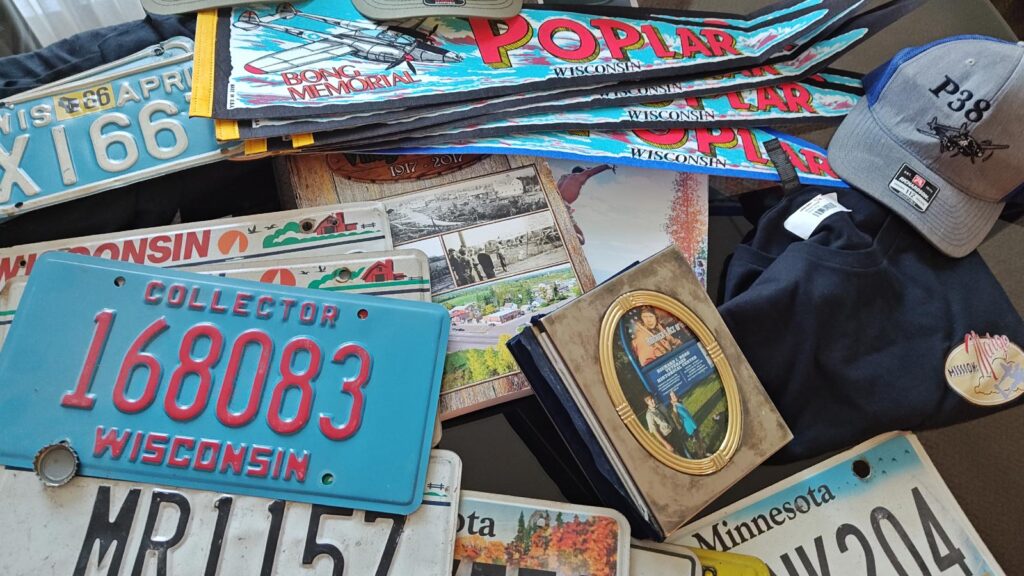
The story begins with Richard I. Bong, a native of Poplar and America’s top fighter ace from World War II, who flew missions from runways in Papua New Guinea.
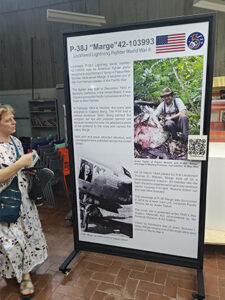 His famous P-38 aircraft, named after his wife, Marge, was discovered near Madang City in 2024 and sparked conversation about building an intentional relationship between the two small communities. In May 2024, the Village Board voted to pursue the connection, sending Gilderman to Papua New Guinea as their representative.
While preparing for the trip, Gilderman made a meaningful personal discovery: his grandfather, who had served with the 43rd Engineer Combat Group, had built the runways Bong used near Madang. “I didn’t know any of this before going on the trip,” Gilderman reflected. “I was reading letters from my grandpa’s compatriot and pieced together the two timelines. It was extra special to find that personal connection beyond our family roots in Poplar.”
Small town, global impact
Poplar, with its population of just over 600, seems an unlikely candidate for international diplomacy. Nestled in the rolling hills and forests of Wisconsin’s South Shore, Poplar and the series of other small towns on U.S. Highway 2 — Maple, Hawthorne, Brule, and Iron River — exude a small-town ethos that embraces community life. As Gilderman explained, “It’s really community-centered and everybody’s very kind to each other and supportive. Pretty much everybody knows everybody.”
This intimate knowledge of and investment in community, where people run into neighbors at the hardware store and encourage each other to run for the Village Board, created the foundation for a meaningful connection with the people of Madang. For Gilderman, the opportunity to develop something beyond empty words and intentions was crucial: “One thing that I made clear before and during the visit to Madang is this isn’t just a signature on a piece of paper; we’re establishing a real relationship,” he emphasized.
Gilderman and Briana Fiandt, the Bong Center’s curator of collections and exhibits, started dreaming about future opportunities to partner with the people of Madang, including potential travel opportunities between locales and selling artisans’ goods at the Bong Center. Students at Northwestern Middle School in Poplar have exchanged letters with students at Bibi Primary School in Madang Province, sharing about their lives, hobbies, families, and what life is like in their respective areas. The Madang leadership returned the sentiment; Governor Pariwa expressed interest in visiting Poplar to try his hand at fishing in the Northwoods.
Finding common ground across cultures
In July 2025, Gilderman — along with his wife, Amanda, and Fiandt — traveled roughly 80 hours to reach Madang City on Papua New Guinea’s northern coast. Here, the group met community members and leaders, including Governor Ramsey Pariwa.
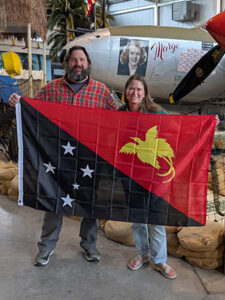 “The first day, some of the officials were skeptical of us, which is normal,” Gilderman shared. “They call it ‘ribbon-cutting fatigue.’ Previous connections with other groups may have caused issues, so there’s a bit of initial distrust. By the second night, after we had dinner with them, they were much friendlier. We were hugging by the end of it.”
Despite the vast cultural differences, Gilderman saw important similarities between Poplar and Madang Province. “We have a lot in common, really. They’re rural. They like fishing. They depend on agriculture. They’re a seaport,” he observed. These commonalities became a foundation for genuine relationship-building, moving beyond diplomatic formalities to an authentic human connection.
Building and exchanging cultures
One noticeable difference between the towns? Poplar doesn’t have a municipal flag so they weren’t able to exchange them…yet. “Now we have one in the works,” Gilderman said. “Our new friends in Papua New Guinea are into flags and wondered why we didn’t have one to share with them. We took the hint and have the middle schoolers working on designs for an upcoming contest.”
Though introduced through the Sister Cities International program, the cities’ relationship is shaped and driven by community leaders. Madang and Poplar leaders are particularly interested in engaging their students in the conversation by facilitating letter exchanges between elementary schools. Additionally, as a longtime St. Scholastica staff member, Gilderman felt at home during a visit to Divine Word University. “They have the same values; their campus has Community Drive and Respect Alley. It was like reading St. Scholastica’s founding book, honestly.”
A community-centric path forward
As Gilderman and the Poplar Village Board continue building the sister city relationship, his story offers an example of how our human connections help us understand where we’ve been, where we are, and where we’re going. “It’s pretty unique, I think, for a small community like Poplar to be connected across the world like this,” Gilderman reflected. But perhaps what makes it unique isn’t the international connection itself, but the authentic, community-centered approach that made it possible.
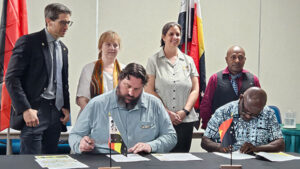 “I like serving in that setting,” he said about Village Board work. When he signed the Sister City agreement with the Provincial Administrator of Madang, he drew on the same community-centered approach that guides his approach to local governance.
This comfortability with civic engagement translated directly to the ability to represent not just Poplar, but the College’s Catholic Benedictine values, on an international stage. Through the experience, he is an official U.S. Speaker through the U.S. Embassy Exchange program. As a former Staff Council Chair and the 2024 recipient of St. Scholastica’s Living Our Values award, Gilderman is no stranger to integrating values into his work and beyond: “I’ve been graced with the privilege to serve in multiple communities and take these roles as the honor of my life.”
In an era when many people feel disconnected despite constant digital communication, Poplar’s path to Papua New Guinea reminds us that genuine community, whether local or global, remains our most reliable compass for navigating an uncertain world. The threads of connection that bind us together, whether through shared history, common values, or mutual respect, create the pathways that help us find our way home, no matter how far we travel.