
May 5, 2026
St. Scholastica Innovation Scholars: Building the future of medicine
A team of undergraduate students from The College of St. Scholastica presented before a panel of medical innovators at the Mayo Clinic in Rochester, MN, on Thursday, February 26. After months of preparation, the presentation culminated with the group gaining hands-on experience in the complex process of translating medical research and innovation into real-world applications.
This work was part of the Innovation Scholars program, a nationally recognized experiential learning initiative that places undergraduate students in multidisciplinary teams to address real-world challenges in healthcare innovation. Often described as taking an idea “from the bench to the bedside,” the program connects students with industry partners, including Mayo Clinic, NASA, and early-stage biomedical companies.
Navigating ambiguity
Over the course of the academic year, St. Scholastica students worked through the scientific, regulatory, and commercial considerations required to bring emerging medical technologies to market. Due to confidentiality agreements surrounding intellectual property, specific project information was limited; however, participants were tasked with analyzing regulatory pathways, assessing market viability, and developing strategic recommendations for their project sponsors.
“Much of our work required navigating ambiguity,” said Biochemistry major Rutendo Kahari ’27, a member of the 2025–26 team. “Unlike traditional coursework, where problems often have clear right or wrong answers, this project challenged us to analyze regulatory pathways, assess market viability, and develop strategic recommendations without a predetermined roadmap. The process was both intellectually demanding and deeply rewarding.”
Engaging with new concepts
Kahari noted that the experience pushed her beyond her academic background, requiring her to engage with new concepts in business and commercialization. “Coming from a strong scientific background, stepping into a commercialization role initially felt like I was ‘cosplaying’ as a woman in business learning the language of markets, licensing, and strategic partnerships in real time,” she said. “This experience strengthened my leadership, collaboration, and creative problem-solving skills while sharpening my business acumen. I am grateful for the support from the mentors from St. Scholastica, Augsburg University, and Mayo Clinic.”
“Being an Innovation Scholar at Mayo Clinic as a computer science student who’s interested in data science allowed me to further strengthen my data science skills while gaining hands-on exposure to real-world healthcare applications,” said Computer Science major Hiba Harrai ’26. “Collaborating with Dr. Christopher Schwarz gave me valuable insight into how these concepts are applied at scale, and our ongoing discussions, despite busy schedules, pushed ideas forward in meaningful ways. Beyond the technical growth, I built strong professional connections and experienced a collaborative environment that I could genuinely see myself being part of in the future. I will forever be thankful for this experience and recommend any student to join.”
A growing presence in innovation
Celebrating its 20th anniversary, the Innovation Scholars program continues to expand its impact across Minnesota and beyond. The College joined the program in 2023 and quickly established itself as a powerhouse contributor, with eight alumni participating in multidisciplinary teams.
The program emphasizes collaboration across majors, bringing together students with backgrounds in biology, business, communications, and data analysis. This interdisciplinary approach reflects the realities of modern healthcare innovation, where scientific discovery is paired with strategy, communication, and market insight.
“Mentoring Innovation Scholars is an incredibly rewarding experience,” said Dr. Mei Sun, associate professor of Psychology. “Watching students from different disciplines collaborate, tackle real-world challenges, and turn their ideas into meaningful outcomes is truly inspiring.”
Reflections from the 2023–24 cohort
For many of the scholars, the program serves as a bridge between academic experience and professional work.
Previous participant Fabian Andrade ’25, a double major in Business Management and Computer Science, completed an internship at Inspire Medical Systems in Minneapolis, MN. “It felt like a real-world environment where the work mattered, which made the experience incredibly meaningful,” Andrade said of the program’s impact. “Being able to collaborate with students from different academic backgrounds and perspectives made the project much stronger and taught me how valuable diverse thinking is when solving complex problems.”
The experience also helped Andrade identify his career interests. “Through that process, I realized that I genuinely enjoyed translating data into insights and decisions,” he said. Andrade now works for Marathon Sports, a retail sports company where his position in People Analytics regularly connects him to clients in Ecuador, Peru, Chile, and Bolivia.
Real-world collaboration
Computer Information Systems major Jad Saouma ’24, another member of the 2023–24 cohort, is pursuing an MBA at Cornell Johnson Graduate School of Management and currently serves as student government president at Cornell Tech. He said the program’s interdisciplinary structure mirrors real-world collaboration.
“One of the main takeaways from the Innovation Scholars program was the interdisciplinary experience,” Saouma said. “It gave us the opportunity to work with people from different academic backgrounds and industries, which reflects the kind of collaboration students will encounter later in their professional careers.”
Captivating learning
Fellow cohort member Sarah Vlasich ’24 now works as a clinical research assistant at the University of North Carolina School of Medicine. “Innovation Scholars played a big role in shaping how I approach research today,” the Biochemistry and Psychology double-major said of the program’s influence. “Since the program, I’ve had the opportunity to start or contribute to six additional research studies. I love what I do! Innovation Scholars set a fire in my heart for research that feels impossible, but that’s exactly what makes the learning so captivating.”
“One of our major deliverables in IS was mapping out how a potential treatment idea could move toward clinical research,” Vlasich continued. “Now that’s part of my role at the UNC School of Medicine’s Center for Women’s Health Research.”
Preparing students for meaningful work
As St. Scholastica continues to be involved with the Innovation Scholars program, the program highlights the College’s role in preparing students for careers at the intersection of science, business, and innovation.
With each cohort, students gain experience addressing real-world challenges while developing skills in collaboration, communication, and critical analysis, which are key components of today’s healthcare and biotechnology industries.
Applications for future Innovation Scholars cohorts will open in the coming months, continuing to expand opportunities for students to engage in experiential learning and contribute to the future of medical innovation. More information about the program is available at the Innovation Scholars website.
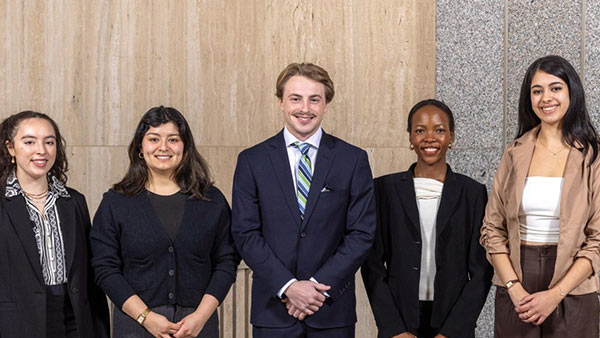
2025-2026 Innovation Scholars
- Lucas Bollback ’26 (marketing)
- Hiba Harrari ’26 (computer science; minor in data analytics)
- Rutendo Kahari ’27 (biochemistry)
- Jessica Martinelli ’26 (biochemistry, chemistry, biology; minor in civic studies)
The team’s campus mentors included Tom Gibbons, Mei Sun, and Kaya Zelazny, with additional mentorship provided by Augsburg University graduate student Gizel Ojeda-Gomez.